Comparison of 3D Printing Technologies: FDM, SLA, SLS, MJF and SLM
AUTHOR: Creallo Marketing Team|2026.05.14
3D printing technologies vary significantly in terms of output quality, material characteristics, and suitable applications. In this guide, we compare the key features, strengths, and limitations of the five most widely used 3D printing methods—FDM, SLA, SLS, MJF, and SLM—to help you choose the best process for your rapid prototyping or functional part needs.
FDM (Fused Deposition Modeling)
FDM is a widely used 3D printing method that extrudes thermoplastic filament layer by layer to build parts. It allows the use of standard industrial materials like PLA and ABS, but has relatively low dimensional accuracy, visible layer lines, long printing times, and anisotropic mechanical properties depending on the print orientation. FDM is best suited for visual prototyping or educational purposes.
Advantages
- Compatible with standard injection molding plastics (PLA, ABS)
- Low material cost and wide color variety
Limitations
- Low resolution and slower printing speeds
- Mechanical properties vary with print orientation
- Post-processing difficulty depends on material
Best Applications
- Simple prototypes
- Educational models
- Basic geometry validation
Materials
- Thermoplastic filament (e.g., PLA, ABS) with coarse surface finish

SLA (Stereolithography)
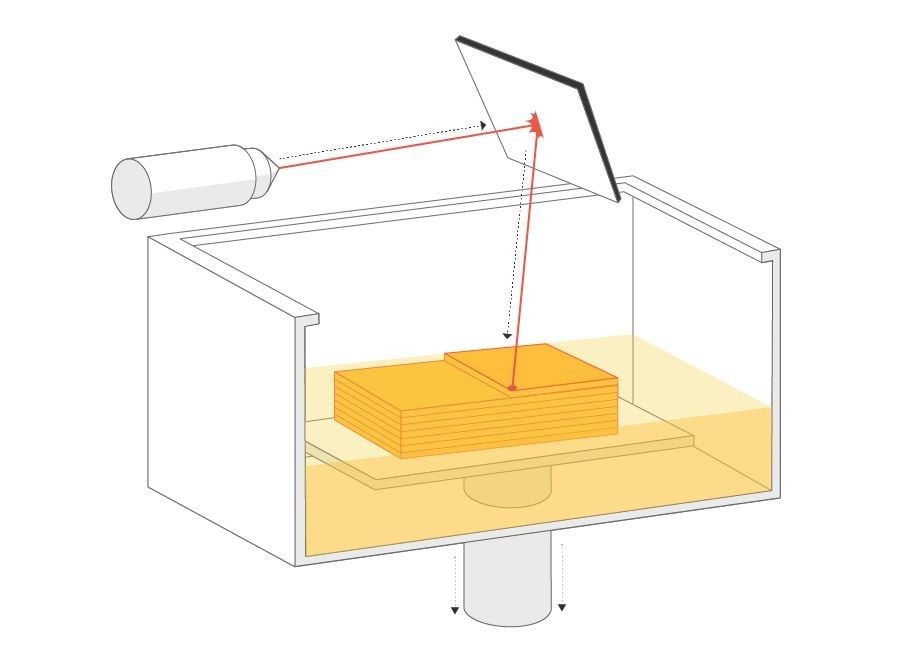
SLA uses a UV laser to cure liquid resin layer by layer, offering high precision and smooth surfaces. While SLA resins may not match the mechanical strength of thermoplastics, they provide excellent dimensional stability, fast build speeds, and ease of post-processing. SLA is the most commonly used method in industries requiring accurate visual models.
Advantages
- Very high resolution and surface detail
- High productivity and fast turnaround
- Easy to sand, paint, and finish
Limitations
- Limited material and color options
- Lower mechanical strength compared to thermoplastics
- Requires additional cleaning and post-curing
- Susceptible to UV and heat deformation
Best Applications
- Precision prototypes
- Design validation models
- Jewelry and dental models
Materials
- Photopolymer resins with smooth finishes and excellent detailing

SLS (Selective Laser Sintering)
SLS uses a laser to sinter powdered nylon layer by layer. It produces strong, functional prototypes without support structures, making it ideal for complex geometries. SLS offers high mechanical strength and is the most recommended plastic-based 3D printing method for functional testing.
Advantages
- Excellent strength, heat resistance, and durability
- No support structures needed
- Suitable for complex internal geometries
- Materials can be dyed in various colors
Limitations
- Rough surface finish
- Requires extensive post-processing
- Weaker mechanical properties along the Z-axis due to anisotropy
Best Applications
- Functional prototypes
- Durable parts under mechanical stress
Materials
- PA12 (nylon), with options like PA11 for eco-friendliness and biocompatibility
MJF (Multi Jet Fusion)
MJF also uses nylon powder but employs inkjet arrays to selectively fuse layers. It delivers consistent strength in all directions and supports high-volume production. Though slightly more expensive than SLA, MJF offers superior material properties with PA12 and increasingly supports advanced materials.
Advantages
- Fast build speed and high productivity
- Uniform strength across all axes
- Ideal for functional prototypes and end-use parts
Limitations
- Coarse surface finish without post-processing
- Limited to dark colors—difficult to achieve true white
Best Applications
- Functional parts requiring mechanical strength
- Short-run production
Materials
- PA12, PA11, glass-filled nylon, TPU, and PP
SLM (Selective Laser Melting)
SLM is a metal 3D printing process that melts metal powders layer by layer using a high-powered laser. While SLM cannot match the surface finish of CNC machining, it enables cost-effective, short-lead time production of complex metal parts that would otherwise require 5-axis machining.
Advantages
- Direct printing of high-strength metal components
- Excellent thermal and mechanical performance
- Supports a range of industrial-grade alloys
- Suitable for low- to mid-volume production
Limitations
- Requires post-processing (e.g., CNC machining) to correct distortion
- Rough surface finish
- Complex post-processing requirements
Best Applications
- Aerospace, automotive, and medical components
- Custom metal parts with complex geometries
Materials
- Stainless steel, aluminum, titanium, and other metal powders
3D Printing Technology Comparison Table
Advantages | Limitations | Best Applications | Key Materials | |
|---|---|---|---|---|
| FDM |
|
|
|
|
| SLA |
|
|
|
|
| SLS |
|
|
|
|
| MJF |
|
|
|
|
| SLM |
|
|
|
|
In today’s manufacturing landscape, laser-based 3D printing methods like SLA, SLS, and SLM are the most widely adopted. Understanding the strengths and trade-offs of each process is key to choosing the right 3D printing solution for your product development, whether it’s for visual validation, rapid prototyping, or full-scale production.