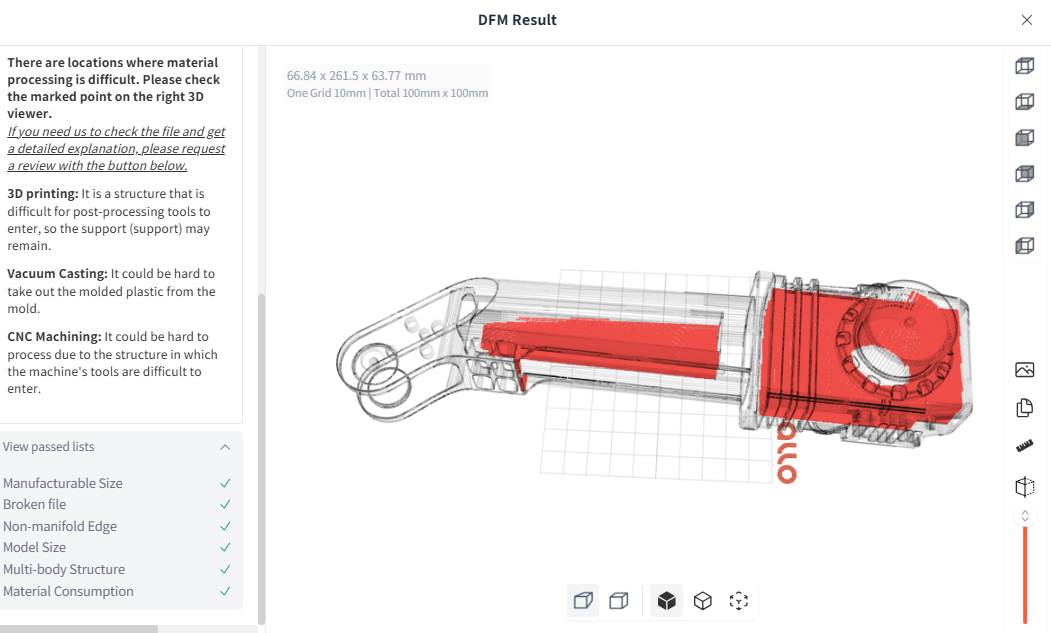
What Is Vacuum Casting? Process, Pros & Cons, and Materials
AUTHOR: Creallo Marketing Team|2026.06.22
Vacuum casting (also called urethane casting) is a manufacturing process that pours liquid resin into a silicone mold under vacuum, producing dozens of parts from a single mold — without the cost of injection mold tooling. It delivers near-production-quality plastic parts quickly and affordably, which makes it a go-to choice for design validation before injection molding and for low-volume production.
Compared with printing parts directly in small quantities, vacuum casting is often faster and more cost-effective for medium-to-large parts and flexible materials — so mechanical engineers frequently reach for it during product development.

How Vacuum Casting Works: 5 Steps
Vacuum casting is a relatively simple process, but managing each step is what determines final quality.
- Master pattern — Create the master model with SLA 3D printing or CNC machining.
- Silicone mold — Encase the master in liquid silicone, let it cure, then cut it open and remove the pattern.
- Vacuum pour — Pour liquid resin into the mold under vacuum so it fills completely without trapped air bubbles.
- Cure & demold — Allow the resin to cure, then remove the part from the mold.
- Finishing — Trim the gate, then apply surface finishing, painting, and other secondary operations.
A single silicone mold typically yields about 20 parts (roughly 10–20 pours). When you need more, additional molds are made.
Advantages of Vacuum Casting
- Fast, low-cost tooling — Dramatically cheaper and quicker than cutting steel injection mold tooling.
- Built for low volumes — Reliably reproduces dozens of parts from a single mold.
- Near-production quality — Resins similar to production plastics give consistent parts that can be hard to tell apart from molded ones.
- Wide material range — From ABS-like, PC-like, and PP-like resins to rubber-like (TPU) and transparent materials. Multi-material (two-shot-style) parts are also possible.
- Flexible finishing — A full range of colors, painting, and printing makes it well suited to final validation.

Limitations to Know
- Thermoset resins only — Materials are limited to polyurethane-based thermosets (urethane, epoxy, and silicone families).
- Property differences vs. injection materials — Cast resins approximate, but don't exactly match, production thermoplastics. Be clear about what you're validating (design, fit, function, feel).
- Volume ceiling — Beyond a few hundred parts, mold wear makes the process inefficient; at that point, consider injection molding.
Available Materials
Creallo supports a broad range — ABS-like, PC-like, PP-like, rubber-like (TPU/PU), and transparent resins. Rubber-like materials in particular replace rubber and silicone to produce flexible yet durable parts. See Creallo's vacuum casting materials for the full list.
When Vacuum Casting Makes Sense
Vacuum casting is the right call when you need a small but consistent batch of prototypes, or fast, cost-efficient validation before committing to injection mold tooling.
| Situation | Why it fits | Vacuum casting advantage |
|---|---|---|
| Batch of prototypes (10–100) | Need a set quantity for testing, marketing, or display | Reliable repeatability from one silicone mold |
| Pre-injection validation | Confirm design and function before cutting tooling | Catch design errors early, save tooling cost |
| Tight budget or lead time | High upfront tooling cost and lead time are a concern | Low upfront cost, parts in ~1–2 weeks |
| Flexible-material samples (TPU, etc.) | Hard to achieve with CNC or 3D printing | Produces flexible, elastic parts |
For a full comparison of when to choose 3D printing, CNC, or vacuum casting → Prototyping process comparison: 3D printing vs. CNC vs. vacuum casting.
Applications
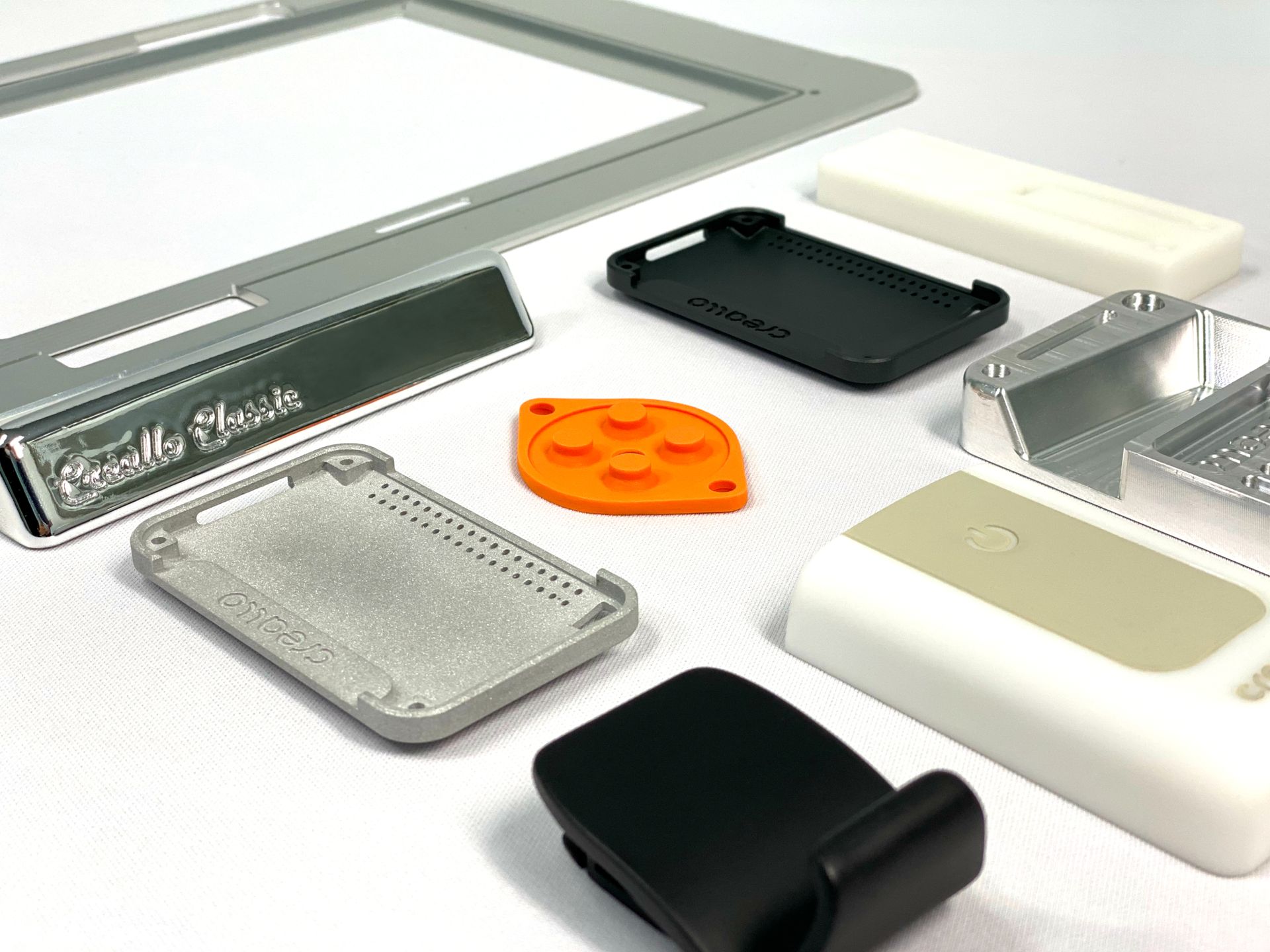
Vacuum casting shines for flexible-material samples and limited test runs across industries.
Here are some examples of applying vacuum casting for production:
- Wearable bands: 50 TPU samples for fit and wear testing

- Appliance button: durability and feel validation before injection tooling

- Medical device housings: 30 sets for trade-show demos, on a short timeline

- Delivery-robot housings: 10 sets of large body covers, delivered fast

You can see real vacuum casting projects from Creallo in our 3D printing, CNC & vacuum casting portfolio | Creallo.
FAQ
Q. How many parts can one mold produce?
A. Typically around 20, depending on geometry; additional molds are made for higher volumes.
Q. What's the minimum quantity?
A. As few as one, but vacuum casting is most economical in the 10–100 range.
Q. What tolerances are achievable?
A. Typically ±0.5% of the nominal dimension, with a minimum of ±0.5 mm.
Q. What's the lead time?
A. Usually about 1–2 weeks.
Q. How does quality compare to injection-molded parts?
A. Very close, though materials are limited to thermosets, so some property differences exist.
Vacuum Casting with Creallo
Vacuum casting is a practical answer when you need speed, cost, and quality together — for pre-production validation or low-volume runs. Not sure whether to build your master with 3D printing or CNC, or at what quantity vacuum casting becomes the economical choice? Creallo's engineering team reviews your part, quantity, and cost targets and recommends the right process.
Get an instant online quote — just upload your 3D file to see pricing and lead time.

Related Link:
![[Case Study] Revolutionizing Semiconductor Component Manufacturing: How Creallo Cut Lead Times by 70% Without Tooling](https://admin-atch.creallo.com/admin/file/generic/1776755700799-1355c3bc39142c27.png)