How to Evaluate an Overseas Manufacturing Partner: 7 Questions to Ask
AUTHOR: Creallo Marketing Team|2026.07.27
Key Takeaways
- Ask 7 specific questions before sending CAD files overseas: process ownership, IP protection, DFM, tolerances, lead time, QC policy, communication
- Red flag: vague answers like "we have quality control" instead of a described mechanism
- Use this before committing to any new manufacturing partner, not just first-time sourcing
Sending your CAD files overseas feels risky. Here's exactly what to check before you commit.
Whether you're sourcing your first production run or adding a backup supplier, the difference between a smooth partnership and a costly mistake usually comes down to a handful of questions you should ask before you send a single file.
Here are the seven that matter most.
1. Do they actually understand how your parts are made — or just relay the order?
Not every "manufacturer" you contact actually runs the equipment your parts will be made on. Many platforms operate purely as brokers: they take your order, quote it, and forward the job to a third-party factory they have limited visibility into. That doesn't automatically mean lower quality, but it does change who's accountable — and how deep their process knowledge actually goes — when something needs to be resolved.
Pure broker model:
- Your point of contact doesn't operate the machines
- Process knowledge and quality control live entirely with a separate factory, sometimes several layers removed
- A production issue has to pass through an intermediary before it can even be diagnosed
Hybrid model (in-house + partner network):
Some manufacturers run part of their production in-house and route the rest through a vetted partner network — using each for what it does best. The advantage only holds up, though, if the manufacturer actively manages the quality gap between the two rather than treating outsourced work as a black box.
Creallo runs 3D printing largely in-house, while CNC, injection molding, vacuum casting, and sheet metal are also produced through a partner network. Because part of production happens on Creallo's own floor, the team has direct, first-hand process knowledge — and applies that same standard when overseeing partner-manufactured parts. To keep quality consistent across both, Creallo runs QC checks at both HQ and its China branch, specifically to close the gap between in-house and partner-manufactured output rather than assuming it away.
Ask any potential partner directly: "Which processes do you run yourselves, and how do you control quality on anything you outsource?" A partner with a real answer — not just "we have quality control" — will describe an actual mechanism, not a slogan.
2. How do they protect your IP?
Sending proprietary CAD files to any third party is a real exposure point, and it's reasonable to ask exactly how a manufacturer handles that risk before you send anything.
What ISO 27001 actually means
ISO 27001 is an international standard for information security management systems (ISMS). Certification means an organization has documented and audited processes for how it controls access to sensitive data — including things like who can view uploaded files, how they're stored, and how access is revoked. It's not a guarantee that nothing can ever go wrong, but it does mean the company has a third-party-audited system in place rather than ad hoc practices. Creallo holds ISO 27001 certification.

What a real NDA process looks like
- Clear about who inside the manufacturer's organization can access your files, and what protections are already in place with any manufacturing partners
- Offers a signed NDA upfront if you want one before uploading anything, rather than only after the fact
- Includes a clear data retention / deletion policy for files after a project ends or is declined
Note that some platforms (Creallo included) let you upload files directly to get an instant quote, before any NDA is signed — that's a tradeoff for speed, not a lack of protection. Creallo already has NDAs in place with its manufacturing partners, and if you'd rather sign an NDA before uploading anything, that can be arranged on request. The key is whether that option exists and is easy to ask for, not whether every file transfer requires paperwork by default.
If a manufacturer can't tell you their file access policy, or can't offer an NDA when you ask for one, that's worth noting.
3. Can they handle DFM feedback before production?
Design for Manufacturability (DFM) feedback is the check that catches a problem while it's still a file, not a mold or a part in your hands.
The risk of skipping DFM
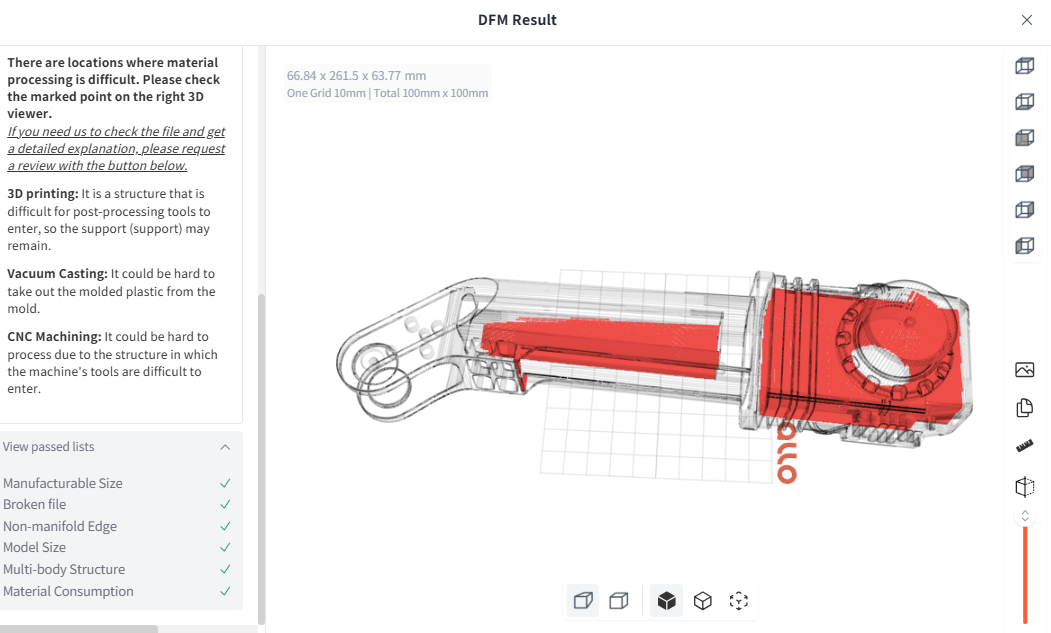
Without a DFM step, a supplier will typically manufacture exactly what you send — including features that can't actually be produced as designed. That might mean walls too thin for machining or undercuts that can’t be reached by a CNC tool.
The cost of catching these issues after tooling or a production run has started is almost always higher than catching them at the quoting stage — in both money and lead time.
How Creallo's AI DFM works
Creallo runs an automated DFM analysis at the point of quoting, flagging manufacturability issues (like thin walls, deep holes, or undercuts) directly on the uploaded model before a human ever needs to review it. This means feedback comes back with the quote itself, rather than after a project has already been scheduled into production. It also saves the back-and-forth that normally happens when a design isn't actually manufacturable as-is — instead of waiting through several rounds of email just to get a quote, you know upfront whether a feature needs to change before you commit any time to it.
4. What are their actual tolerances?
"Tight tolerances" is not a spec — ask for the actual numbers, and ask which process is appropriate for your part.
Here's what Creallo publishes by process:
| Process | Tolerance |
|---|---|
| 3D printing — SLA | ±0.2%, minimum ±0.2 mm |
| 3D printing — SLS / MJF | ±0.3%, minimum ±0.3 mm |
| 3D printing — SLM | ±0.3%, minimum ±0.3 mm |
| 3D printing — FDM | ±0.5%, minimum ±0.5 mm |
| Vacuum casting (casting-process tolerance) | Minimum ±0.3 mm |
| Sheet metal | See laser cutting / bending table below |
CNC tolerances follow ISO 2768:
| Nominal length | General tolerance | Precision tolerance |
|---|---|---|
| Under 6 mm | ±0.1 mm | ±0.05 mm |
| 6 mm – 30 mm | ±0.2 mm | ±0.1 mm |
| 30 mm – 120 mm | ±0.3 mm | ±0.15 mm |
| 120 mm – 400 mm | ±0.5 mm | ±0.2 mm |
| 400 mm – 1000 mm | ±0.8 mm | ±0.3 mm |
General tolerance applies by default; precision tolerance is available on request.
Sheet metal tolerances:
| Feature | Tolerance |
| Laser cutting — length | ±0.2 – ±0.5 mm |
| Laser cutting — hole diameter | ±0.08 – ±0.12 mm |
| Bending angle | ±0.5° – ±1.0° |
The right question isn't "how tight can you go," it's "which process is actually appropriate for this specific feature on my part." A good manufacturing partner will push back if you're over-specifying tolerance for a feature that doesn't need it — that usually signals real process knowledge rather than just a sales conversation.
5. How fast can they realistically deliver?
Lead time quotes are often manufacturing time only — they don't always include shipping, customs, or QC. Ask for the full door-to-door number, not just the "manufacturing" number.
Here's what that looks like at Creallo:
| Process | Production time | + Shipping (by region) | Total (door to door) |
|---|---|---|---|
| 3D printing (SLA/SLS/FDM) | 2–3 business days | 2–6 business days | ~1–1.5 weeks |
| Vacuum (urethane) casting | 3–5 business days | 2–6 business days | ~1.5–2 weeks |
| CNC machining | 3–5 business days | 2–6 business days | ~1.5–2 weeks |
| Sheet metal fabrication | 3–5 business days | 2–6 business days | ~1.5–2 weeks |
A few things worth knowing: the lead time clock starts at order confirmation and DFM approval — not the moment you upload files, so make sure you're comparing suppliers on the same starting point. Rush service is possible (for example, next-day dispatch on in-house 3D printing), but confirm availability before you place the order, not after. And customs is typically on the buyer, not the supplier — most instant-quote suppliers ship DAP (Delivered at Place), so don't assume duties and taxes are bundled into the quote unless it's stated explicitly.
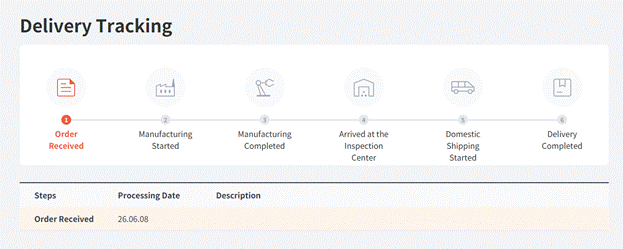
For the full breakdown — carrier transit times by region, DAP vs. DDP, HS codes, and duty/VAT rates by country — see Ordering Custom Parts from Korea: Shipping, Lead Time, and Customs — What to Expect.
Ask any potential partner for the same breakdown: production time, shipping time by your specific region, and whether rush service is realistically available for your process — not just "fast turnaround" as a general claim.
6. What happens when parts fail QC?
Every manufacturer will eventually produce a batch with an issue. What actually matters is what happens next.
Ask specifically:
- Is there a clear window to report a defect, or is it "case by case"?
- If parts fail, do they remake them, refund, or partially credit?
- Does a confirmed defect get prioritized, or does it go back into the standard production queue?
Creallo's policy:
if you receive defective or incorrect parts, contact them within 7 days of delivery with clear photos and a description of the issue. If the defect is confirmed as a manufacturing error, they arrange a re-manufacture at no additional cost — and that re-manufacture is treated as top priority, produced and shipped ahead of standard orders to get correct parts to you as fast as possible.
A manufacturer who has a clear, pre-defined answer to these questions (rather than "we'll handle it case by case") is one who has actually dealt with failures before and built a process around them.
7. Can you actually communicate with them?
Design questions and production issues often need to be resolved quickly, in detail, and in a shared technical vocabulary. This is where a lot of overseas sourcing relationships quietly break down.
- Do you get direct English communication, or does everything route through a translator?
- Is there a single point of contact (dedicated PM) for your account, or does every message start over with a different rep?
- How fast do they typically respond to a technical question mid-production?
Creallo's team communicates directly in English — no translated go-between — by email or through the website inquiry form, with typical response times within 24 hours, and each account is assigned a dedicated PM.
Checklist: 7 questions to ask before you commit
- Do they actually understand how your parts are made, and how do they manage quality across in-house vs. partner-manufactured work?
- What's their IP protection process?
- Do they run DFM checks before production starts, and how automated is it?
- What are their actual tolerance ranges, by process?
- What's the realistic door-to-door lead time, including shipping — and is rush available?
- What's their QC/defect process, and what happens when a part fails?
- Can you communicate directly in English, and is there a dedicated PM?
Get an instant quote with automated DFM feedback on your project.et an instant quote with automated DFM feedback on your project.