Why Engineers Choose 3D Printing for Prototyping: A Process Comparison Guide
Prototyping is a non-negotiable stage in product development. No matter how refined your CAD model is, real-world validation always surfaces issues that simulations miss. The question isn't whether to prototype — it's how to do it efficiently at every stage of development.
This guide breaks down when and why 3D printing outperforms other prototyping methods, and how to choose the right process for each development phase.

The Core Requirement: Fast, Affordable Iteration
Effective prototyping isn't about making one perfect part — it's about compressing the design-test-revise cycle as much as possible. Every day saved in iteration translates directly to faster time-to-market and lower development costs.
That's why process selection matters as much as part quality. The right manufacturing partner should help you choose the right process for each stage, not just execute a single method from start to finish.
Process Comparison: 3D Printing vs. CNC Machining vs. Vacuum Casting
The most cost-effective approach is to stage your process selection across the development cycle — FDM for early form checks, SLA for design reviews, SLS or CNC for functional validation — rather than committing to a single process throughout.
| Process | Best For | Advantages | Limitations |
| 3DP - FDM | Concept models, form check | Lowest cost, fast turnaround | Limited surface quality, lower dimensional accuracy |
| 3DP - SLA | Visual models, design validation | High detail, smooth surface finish | Brittle, UV-sensitive |
| 3DP - SLS/MJF | Functional prototypes, working models | No supports needed, strong and durable, near-production material properties | Higher cost than FDM/SLA |
| SLM (Metal) | Final functional validation | High-strength metal parts, complex geometries | High cost, post-processing required |
| CNC Machining | Functional testing, pre-production | Tight tolerances, true material properties | Geometry constraints, higher setup cost |
| Vacuum Casting | Design validation, low-volume runs | Production-like appearance, wide material options | Mold lead time required |
Why 3D Printing Dominates Early-Stage Prototyping
No tooling cost
Unlike CNC machining or injection molding, 3D printing requires no upfront tooling investment. You can go from CAD file to physical part in days, which is critical when design changes are frequent in early development stages.
Complex geometries without constraints
Internal channels, undercuts, lattice structures, and organic forms that would be cost-prohibitive to machine are straightforward to 3D print. This gives engineers far more design freedom when validating new concepts.
Fast turnaround
Parts can be in your hands within days of finalizing your CAD file. For iterative development cycles where multiple design revisions are expected, this speed directly compresses your overall development timeline.
Multi-variant testing
Need to test three different wall thicknesses or two snap-fit configurations simultaneously? 3D printing makes it practical to run parallel design variants at low cost — something that would be prohibitively expensive with machined or molded parts.

How to Evaluate a Prototyping Partner
When selecting a prototyping service, price per part is only one factor. Consider:
- Process breadth: Can they handle FDM, SLA, SLS, CNC, and casting under one roof — or will you be managing multiple vendors?
- Quality control: Do they provide professional post=processing services and meticulous quality inspections to ensure precision in every part.
- Lead time reliability: Can they meet urgent timelines? Do they guarantee on-time delivery?
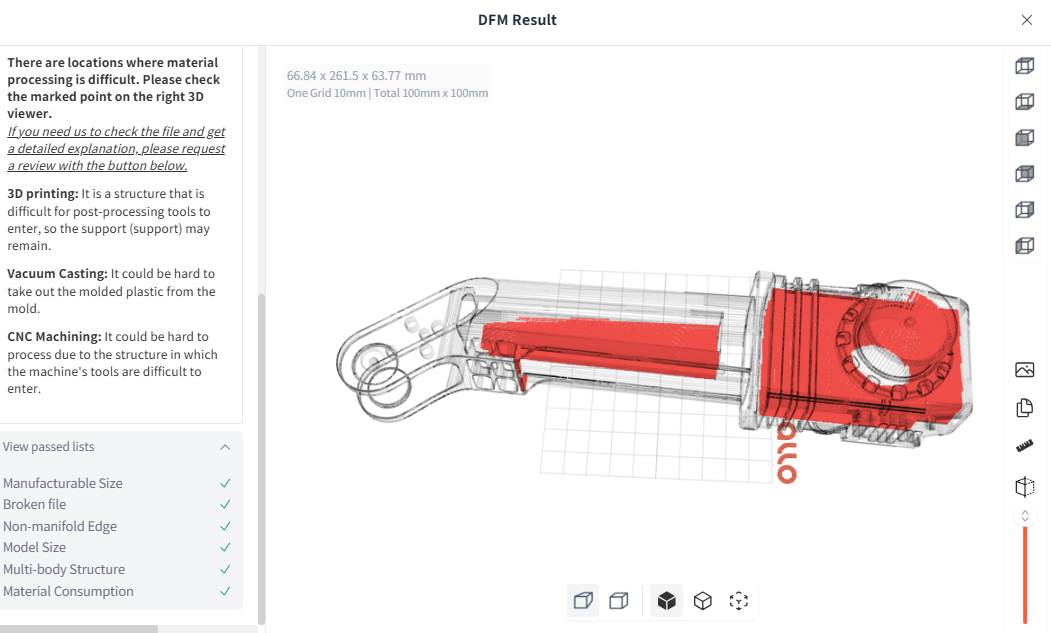
- DFM feedback: Do they flag manufacturability issues before production, or just run the file as-is?
Managing multiple vendors across different processes adds coordination overhead and introduces handoff risks. A single partner capable of handling your full prototyping-to-production workflow reduces both.
Creallo's Prototyping Service

Creallo provides end-to-end prototyping and low-volume production across FDM, SLA, SLS, SLM, CNC machining, and vacuum casting — all from a single platform. Upload your STEP or STL file and receive an AI-generated quote and DFM report in under a minute.
Once your design is validated, the same CAD data can be used to transition into SLS/MJF low-volume production or handoff to CNC or vacuum casting — without re-engineering for a new process. This continuity reduces risk and rework at the production transition stage.
- Full process coverage: FDM / SLA / SLS / SLM / CNC / Vacuum Casting
- Instant AI quote + DFM analysis on upload
- Dedicated PM for process and material optimization
- In-house production facility in Korea — no outsourcing, full quality accountability
- Post-processing in-house: surface finishing, painting, dyeing
- Prototype-to-production transition on the same platform
FAQ
Q. How much does prototyping cost?
A. Costs vary significantly based on process, material, part size, and quantity. The most accurate way to get pricing is to upload your 3D file and receive an instant automated quote — no back-and-forth required.
Q. Do I need a specific file format?
STEP and STL files are both supported. STEP is preferred for CNC and tighter-tolerance applications as it retains exact geometry.
Q. What are your typical lead times?
A. Lead times depend on process and quantity. SLA and FDM parts can often ship within 1–2 business days from our in-house facility. Rush orders are available — specify your deadline at the quoting stage.
Q. Can you support the transition from prototype to production?
A. Yes. Creallo handles the full development cycle — from initial concept models through functional prototypes to low-volume production runs — using the same design data throughout.