
Additional Options for 3D Printing and CNC Machining: Inserts & Tapping
AUTHOR: Creallo Marketing Team|2026.09.18
Key Takeaways
- Threaded inserts and tapping are the two most common ways to add durable threads to 3D-printed and CNC-machined parts.
- Threaded inserts hold up well in plastic parts — especially SLA prints, where threads cut straight into the resin can strip after just 3-5 uses — while tapping cuts threads directly into the material and is the only option for CNC-machined metal parts.
- Use an insert when a plastic part will be fastened repeatedly or needs long-term durability; use tapping for metal parts, or plastic parts that won't see frequent assembly and disassembly.
3D printing, CNC machining, and other manufacturing processes all offer additional options that improve a part's finish and durability. Two of the most widely used are inserts and tapping — especially useful whenever you need to add threads or join parts securely, and both can meaningfully improve how a product performs and looks.
Below, we'll walk through what each option does and how to apply it.
Inserts

For materials where cutting threads directly isn't practical, an insert gives you a threaded feature without machining the material itself. The nut-shaped version is called a threaded insert (or insert nut) — it has internal threads on the inside, and features on the outside that let it press into the material and stay locked in place. These show up constantly in furniture, electronics, and other device manufacturing.
Brass threaded inserts are mainly used in plastic parts — they're not typically used with metal. Creallo's standard offering is a brass knurled insert.
For 3D printing — SLA in particular — inserts are an effective fix for thread wear. Resin threads can strip after as few as 3-5 uses due to the material's properties. Pressing a metal insert into any hole that gets fastened repeatedly holds the screw far more securely and meaningfully improves the durability of SLA parts. When modeling, size the insert hole 1-2mm smaller than the insert's outer diameter.
If you're designing around an insert, use the sizing reference below.
Insert Sizing Reference (example)
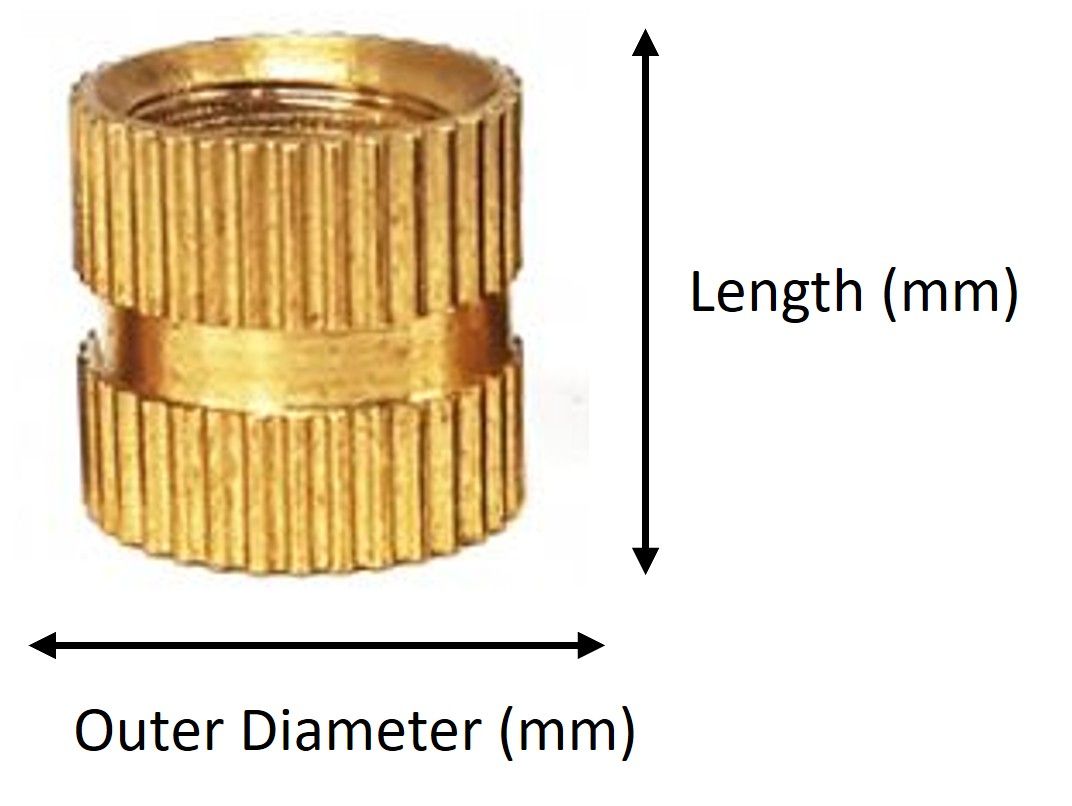
| (Unit: mm) | ||
| Insert Size (ID) | Length (L) | Outer Diameter (D) |
| M1 | 1.5 | 2 |
| M1.4 | 1.5 | 2.3 |
| M1.6 | 2 | 2.5 |
| M2 | 2 | 3.2 |
| M3 | 3 | 4.2 |
| M4 | 4 | 5.5 |
| M5 | 4 | 7 |
| M6 | 5 | 8 |
| M8 | 6 | 10 |
* Keep at least 1mm of wall thickness around the insert — 1.5-2mm is ideal. | ||
Tapping

Tapping cuts threads directly into the part, which makes assembly and disassembly straightforward. It's widely used on both metal and plastic parts, and M-TAP (metric threading) covers the vast majority of requests. For any other thread standard, check with us first to confirm it's supported.
For 3D-printed parts, you can choose between an insert or tapping depending on the material and how the part will be used. For CNC-machined metal parts that need threads, though, tapping is the only option. Mark the tap location, thread spec, and size directly on your STEP file and 2D drawing so we can machine the part accurately.
Use the table below for hole sizes suited to tapping.
Hole Sizes for Tapping
(Unit: mm) | |
| Thread Size | Hole Size |
| M1 | 0.8 |
| M1.4 | 1.2 |
| M1.6 | 1.4 |
| M2 | 1.7 |
| M3 | 2.6 |
| M4 | 3.5 |
| M5 | 4.4 |
| M6 | 5.3 |
| M8 | 7.2 |
FAQ
Q: When should I use an insert instead of tapping?
Whenever a plastic part will be fastened and unfastened repeatedly, or the threads need to hold up over time. Insert threads outlast threads cut straight into resin or plastic, which matters most with SLA parts.
Q: Can I tap threads into a metal CNC part?
Yes — for CNC-machined metal parts, tapping is actually the only option. Inserts aren't used with metal.
Q: What hole size do I need for an insert or a tap?
It depends on the thread size — see the insert sizing table and the tapping hole-size table above, or check with a Creallo engineer if you're not sure.
Start Your Production with Creallo
In this post, we covered how inserts and tapping are used across 3D printing, CNC machining, and other manufacturing processes, along with what each one is good for.
Both play an important role in a part's finish and durability, and which one to use comes down to material and application. 3D printing can produce threads as part of the print itself, but printed threads may not hold up as well or last as long as you'd expect. So whenever a part needs threads, an insert or tapping is the better call — and if the part will be fastened repeatedly or needs high durability, go with an insert. For metal parts, tapping is the only option.
Not sure whether to use an insert or tapping for your 3D-printed or CNC part? Talk to a Creallo engineer.

You may also be interested:
![[Case Study] Creallo X Lanipet: From Prototype Validation to Eco-Friendly Injection Molding](https://admin-atch.creallo.com/admin/file/generic/1787814756887-ed36c9963a6c4be3.png)