From Precision Transparent Parts to Prototypes: High-Quality Transparent 3D Printing Beyond CNC
AUTHOR: Creallo Marketing Team|2026.02.09
Transparent parts are essential in product development for observing internal fluid flow, verifying component interference, and testing LED lighting housings. In the past, engineers had to rely on expensive CNC machining of acrylic or long-lead-time mold manufacturing. However, CNC has limitations with complex geometries or undercuts, and molds carry the risk of extremely limited modifications or immense costs. Transparent SLA 3D Printing breaks these constraints, offering a superior alternative to realize precise transparent parts quickly and cost-effectively.
However, using 'transparent material' does not guarantee identical results. Many engineers are disappointed to receive parts with rough surfaces or a yellowish/bluish tint despite ordering high-clarity options. Transparent 3D printing is a high-difficulty process that requires not only precise equipment settings but also expert post-processing know-how to achieve 'acrylic-like clarity.'
In this blog, we share the causes of quality differences in transparent parts and key insights for failure-free design.
Technical Characteristics of Transparent SLA
The material used in transparent 3D printing is a specialized SLA resin that achieves an acrylic appearance, satisfying both the functionality and accuracy required for prototypes.
Surface Hardness
72-78 Shore D (ASTM D 2240). The hard surface is ideal for achieving a smooth, high-gloss polish.
Tensile Strength
25-30 MPa (ASTM D 638). These mechanical properties allow for use as functional prototypes.
Thermal Properties
Stable in room-temperature operating environments with a Heat Deflection Temperature (HDT) of 50-60°C and a Glass Transition Temperature (Tg) of 55-70°C.
*Technical values are based on the datasheet of the transparent resin used by Creallo.
The Difference in Quality: What Determines Transparency?
Even with the same equipment and materials, quality varies by manufacturer due to 'process management details.' Creallo delivers overwhelming quality in transparent 3D printing across its domestic and global networks.
Smooth Surface Finishing through Expert Craftsmanship
The clarity of a part depends on its surface roughness. Creallo goes beyond simple polishing; our expert finishing process perfectly removes layer lines to achieve peak surface quality that allows light to pass through without scattering.
Data-Driven Precision Process Control
Yellowing occurs due to a lack of complex process control—such as minute errors in UV intensity or excessive post-curing time. Creallo strictly adheres to recommended guidelines (18-25°C) and minimizes yellowing through its proprietary curing database.
Transparency Options by Application: 'Translucent' vs. 'High Clarity'
Choosing the right finishing option helps reduce unnecessary costs while achieving the best effect for your specific use case.
Standard Translucent
- Process: Applying Bead Blast (rubbing fine particles onto the raw material surface).
- Features: Provides a matte, soft translucent texture.
- Recommended for: LED diffusers, basic internal interference checks, and cases requiring cost-effective post-processing.
Premium High-Clarity
- Process: High-quality polishing followed by specialized UV coating.
- Features: Capable of achieving transparency similar to acrylic.
- Recommended for: Automotive headlights and high-quality exhibition prototypes.
Essential Considerations for Design and Manufacturing
Perfect transparent parts start with an engineer's smart design.
Minimize Internal Supports
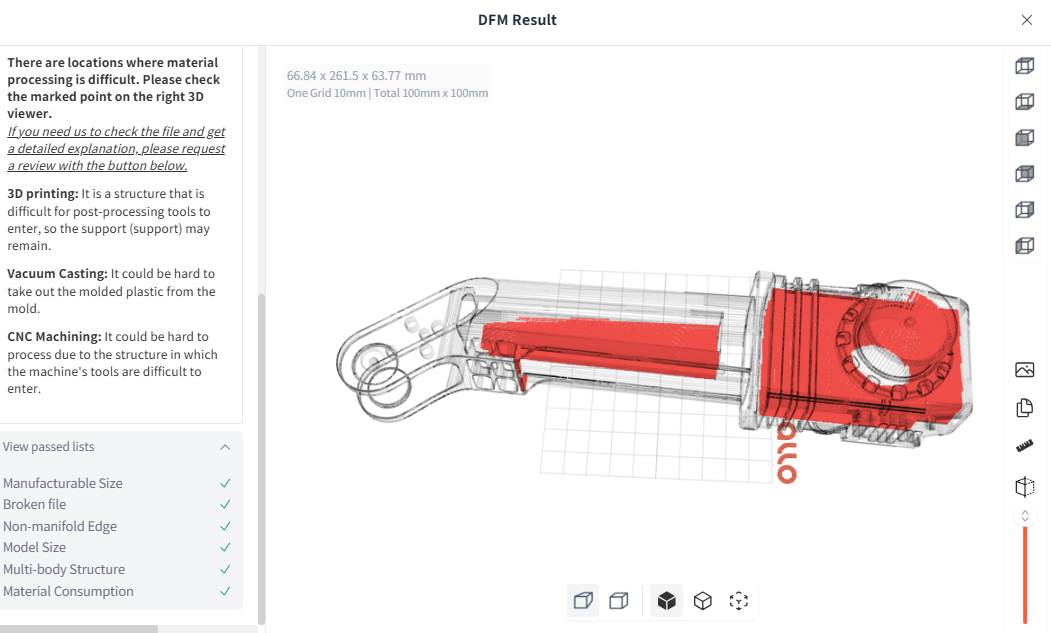
Supports inside closed structures cannot be removed, resulting in left-over support marks or opaque areas.
Optimize Wall Thickness
If walls are thicker than 3mm, the subtle natural tint of the material may be emphasized, making the part appear less transparent.
Design for Manufacturing Tolerances
It is safer to design with manufacturing tolerances (±0.2%, minimum ±0.2mm) in mind to account for dimensional changes that may occur during precision polishing.
Comparison of Manufacturing Processes
| Feature | Transparent SLA 3D Printing | Transparent CNC Machining | Vacuum Casting |
| Quality | Excellent (Post-processing required) | Good (Focus on flat surfaces) | Moderate |
| Geometric Freedom | Unlimited (Complex shapes possible) | Low (Tool interference) | Moderate |
| Production Speed | Very fast (Min. 1 day) | Moderate (5-7 days) | Slow (10+ days) |
FAQ
Q: How transparent is it? Is it as clear as acrylic?
A: Directly after printing, parts have a frosted, opaque appearance. After Creallo’s precision polishing and UV coating process, you can achieve a level of transparency where the interior is clearly visible.
Q: Does transparent resin have heat resistance?
A: Standard transparent resin can deform at temperatures around 50°C. If a high-temperature environment is required, you can find alternatives such as high-heat materials or transparent CNC machining through Creallo’s technical consultation.
Q: How is the production cost determined?
A: It is determined by both the volume of the part and the surface area requiring post-processing (polishing). You can check an automated quote in just one minute by uploading your file to Creallo.
Why Do Experts Choose Creallo?
Creallo guarantees top-tier transparency through the largest direct infrastructure in Seoul and a verified global manufacturing network. We don’t just deliver prints; we apply Creallo’s rigorous post-processing guides and quality standards across all domestic and international production lines.
The reason we achieve stunning quality—even through our global network—is the combination of thorough process management and irreplaceable finishing technology. Furthermore, if transparent 3D printing is not the optimal choice for your specific geometry or quantity, Creallo can review alternative processes like CNC machining. This helps reduce unnecessary design changes or re-fabrication during the prototyping stage, allowing for a more efficient choice of manufacturing method suited to the product's purpose.
When mass production is eventually required, you can seamlessly scale your production quantity based on the same drawing data and quality standards, maintaining a continuous flow from development to mass production.
From Design to Product. Fast and Accurate.
Eliminate manufacturing uncertainty with Creallo’s data-driven system and the touch of experienced experts.
Read More:
- Learn more about Creallo 3D Printing Services >>
- View details on Creallo Transparent 3D Printing Material >>
- View Manufacturing Portfolio >>