
Plastic Injection Molding Basics
Plastic injection molding is one of the most widely used manufacturing processes, where thermoplastic resin is heated, melted, and injected into a mold to mass-produce identical parts.
This injection molding process is highly optimized for large-scale production, capable of producing anywhere from thousands to hundreds of thousands of injection molding parts. At scale, it offers excellent cost efficiency—bringing the unit price down to just a few cents per piece—while maintaining high precision with tolerances of ±0.05 mm or less.
Today, plastic injection molding services are essential across industries, manufacturing everyday products such as automotive parts, medical devices, electronic housings, and consumer goods.
Injection Molding Process Cycle
The injection molding cycle consists of four main stages.
| Step | Description | Typical Time |
|---|---|---|
| 1. Clamping | The mold is tightly closed to withstand high injection pressure | Seconds |
| 2. Injection | Molten resin is injected through the gate | Seconds |
| 3. Cooling | The part solidifies and stabilizes in shape | Seconds–minutes |
| 4. Ejection | The finished part is ejected from the mold | Seconds |
A full cycle usually takes 20–60 seconds, depending on part geometry, thickness, and material.
Advantages and Disadvantages
Advantages
- Cost reduction at scale: unit cost decreases significantly with large production volumes
- Precision and repeatability: excellent dimensional consistency for mass production
- Material diversity: over 18,000 thermoplastics available (ABS, PC, PP, Nylon, PEEK, etc.)
- Complex geometries: supports undercuts and intricate features
- Recyclability: sprues and runners can be reground and reused
- High throughput: thousands of parts produced per day
Disadvantages
- High upfront tooling cost: molds cost thousands to tens of thousands of dollars
- Long lead time: mold fabrication takes 4–8 weeks
- Limited design flexibility: costly to modify designs after tooling
- Not economical for low volumes: CNC machining or 3D printing is better suited for small batches
Prototype Molding
Prototype molds are often created to verify designs before committing to full-scale tooling.
- Purpose: design validation, user testing, marketing samples
- Methods: single-cavity mold, aluminum tooling, or quick-turn molds (QDM)
- Benefit: identify design issues early, reduce unnecessary costs
Prototype molding is especially important in regulated industries such as medical, automotive, and electronics.
Injection Molding Machine Components
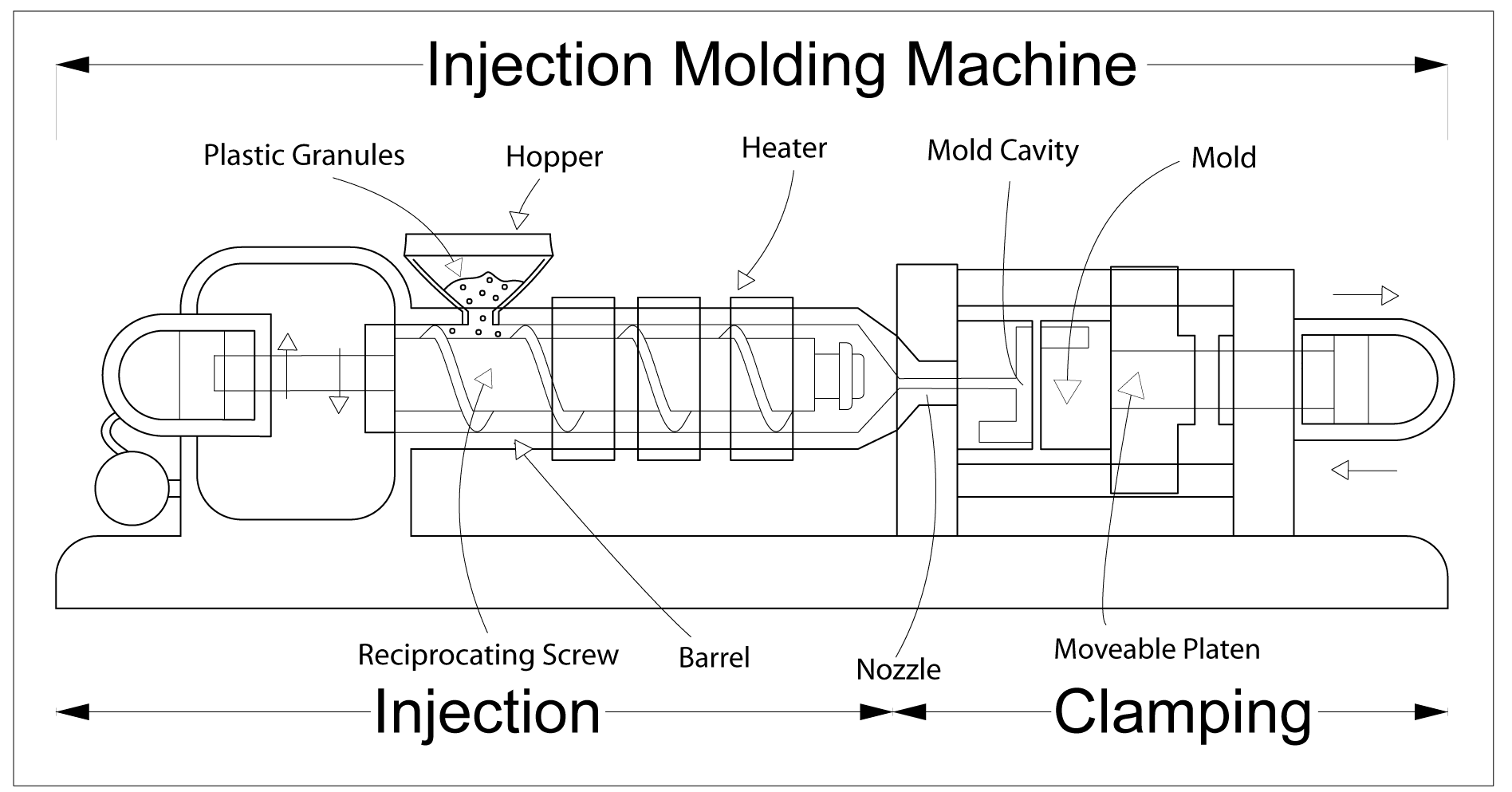
| Component | Location | Function | Description |
|---|---|---|---|
| Hopper | Top of the barrel | Feeds raw plastic pellets, removes moisture | Funnel-shaped inlet |
| Pellets | Hopper / barrel | Raw thermoplastic material | Small uniform granules |
| Barrel | Center of machine | Melts, mixes, compresses resin | Cylindrical tube with heater bands |
| Heaters | Around the barrel | Provide thermal energy to melt pellets | Metal heating bands |
| Reciprocating Screw | Inside barrel | Mixes, compresses, injects resin | Helical screw |
| Nozzle | End of barrel | Directs molten resin into mold | Heated tapered outlet |
| Movable/Fixed Platen | Mold mounting area | Clamps mold halves together | Large metal plates |
Mold Components
| Component | Function | Feature |
|---|---|---|
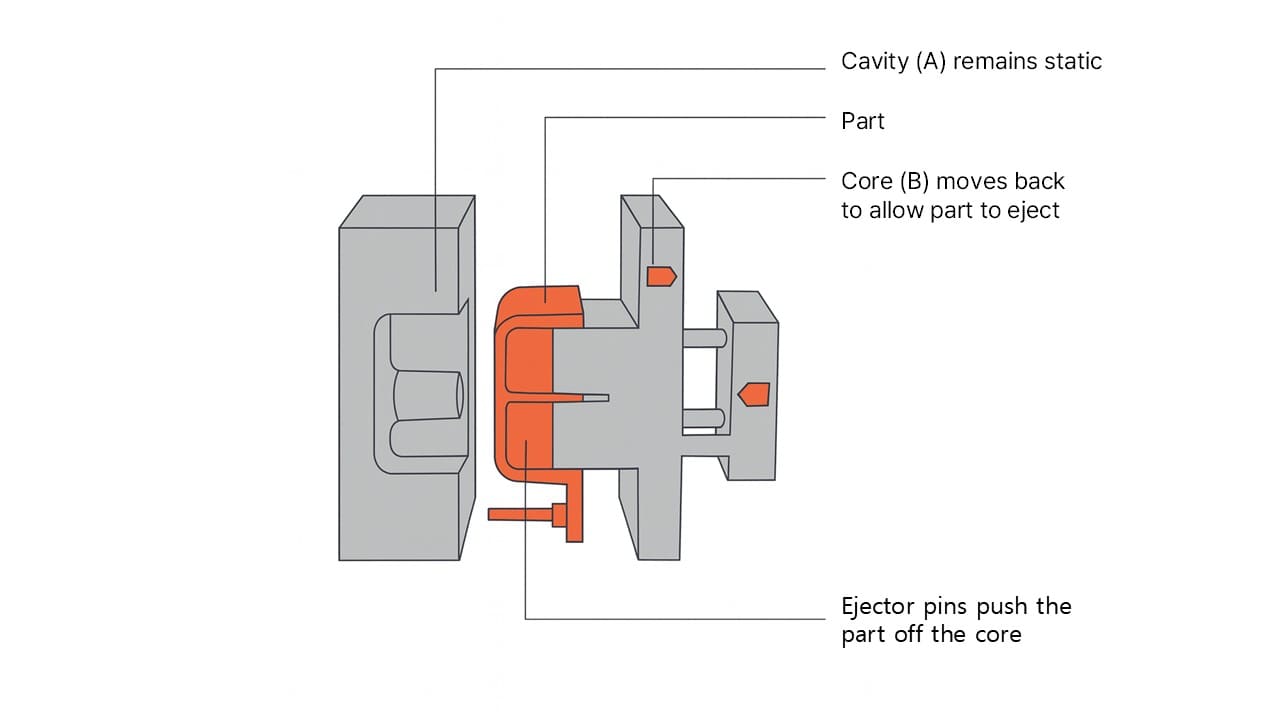
| Cavity / Core | Defines external and internal geometry | Upper/lower mold halves, critical to quality |
| Runner / Gate | Directs resin flow into cavity | Runner = channel / Gate = entry point |
| Ejector / Ejector Pins | Push molded parts out of mold | Prevents part damage, ensures smooth release |
| Cooling Channel | Rapid cooling for dimensional stability | Shortens cycle time |
| Mold Base | Supports and secures all components | Frame structure |
Mold materials: typically S50C, P20, H13 steel, with surface treatments (hardening, nitriding, etc.) applied for durability.
Types of Molds
Injection molds are classified into different types depending on production volume and purpose.
| Mold Type | Feature | Application |
|---|---|---|
| Single cavity | Produces 1 part per cycle | Prototypes, low volume |
| Multi cavity | Produces 2, 4, 8+ parts per cycle | High-volume production |
| Family mold | Multiple different parts in one mold | Assembly sets |
| Insert mold | Embeds metal inserts into parts | Connectors, machine parts |
| Overmold | Combines two materials (e.g., ABS + TPU) | Power tools, toothbrush handles |
| MUD mold | Quick-change insert system | Prototyping, small batch |
Applications
Injection molding is used across virtually every industry:
- Automotive: bumpers, engine parts, interior panels
- Electronics: housings, keycaps, connectors
- Medical: casings, transparent parts, device housings
- Consumer goods: containers, toys, kitchenware
- Industrial parts: valves, seals, machine housings
Injection molding remains the most widely used manufacturing process thanks to its scalability, cost efficiency, and precision.
However, due to the high upfront tooling cost, it is important to evaluate production volume, design stability, and alternatives like CNC machining or 3D printing.
At Creallo, we support everything from prototype molds to full-scale injection molding production.
Upload your design today and get an instant AI-powered quotation.
